What is a Thermal Barrier Coating?
A thermal barrier coating, often referred to as TBC, is used to protect a vulnerable substrate from the effects of an external heat source. This is achieved by reducing the flow of heat onto the substrate and requires a coating with low thermal conductivity.
How Do Thermal Barrier Coatings Work?
Thermal barrier coatings work because their structure prevents heat from transferring onto the substrate below by either conduction or convection.
Thermal conduction will take place if there is a temperature gradient across a solid or a ‘stationary’ liquid or gas. The word ‘stationary’ is important here because if a liquid or gas can move then convection will usually be the dominant form of heat transfer. Energy is transferred from more energetic to less energetic molecules when these neighbouring molecules collide. Thermal conduction occurs in the direction of the decreasing temperature since higher temperatures are associated with higher molecular energy.
Thermal convection is the transfer of heat from one area to another through the movement of fluids or gas. This transfer of heat through moving gasses or liquids requires enough of the gas or liquid for convection currents to work.
A small pocket of gas will not be sufficient for convection, much like the way double glazed windows reduce heat loss from a building. For example, an air gap of around 10mm ensures very low convective heat transfer, with conduction also being very low. With a thicker air gap, convection increases rapidly, so more heat is transferred. A thinner air gap means that convection is low, but heat conduction increases.
The temperature drop is directly proportional to the thickness and inversely proportional to the thermal conductivity value of the material. Therefore, calculating the optimum combination ensures the maximum thermal protection offered.
What Materials Are Used for Thermal Barrier Coatings?
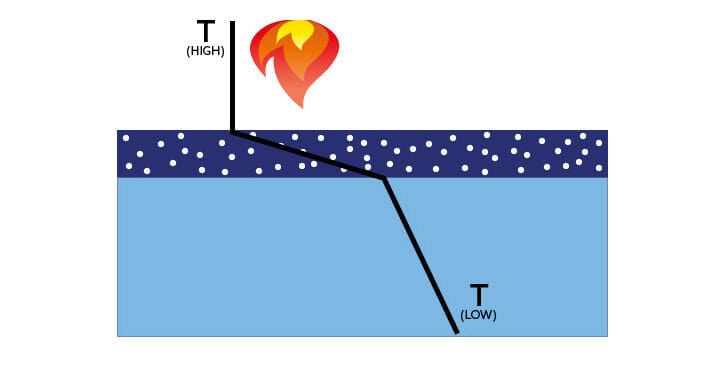
The material type used in a thermal barrier coating, combined with ensuring there is the optimum porosity during the application to create small air gaps, creates the thermal barrier layer with a structure that does not readily allow for conduction or convection. Therefore, the best thermal barrier coatings are as thick as possible and have a very low value of thermal conductivity.
The illustration shows that the substrate (light blue) is being protected from a high external heat source (such as a radiant heat source or impinging hot gas) by the thick coating of low conductivity (dark blue). It also shows a level of porosity within the barrier layer that is very deliberate. The small air pockets (white dots) provide regions of low conductivity without being large enough to allow convection.
This table shows the thermal conductivity levels for some typical materials (the lower number the better).
| Material | Thermal Conductivity (W/m/°C) |
| Mild steel | 401 |
| Copper | 43 |
| Aluminium | 205 |
| Aluminium oxide | 30 |
| Chromium oxide | 25 |
| Zirconia (yttria stabilised) | 3 |
| Zirconia (yttria stabilised) with 20% porosity | 2 |
| Air | 0.024 |
Therefore, ceramic coatings such as yttria stabilised zirconia with deliberately added porosity provide the best thermal barrier coating. However, it is important to note that the porosity level should not be too high or else the ceramic will become fragile.
What Applications Are There For Thermal Barrier Coatings?
Thermal protection is required in a range of applications and industries. Some typical uses of thermal barrier coatings include:
- Engine exhaust systems
- Gas turbine engines
- Aerospace engines
- Pyrochemical reprocessing units
- Turbocharger casings
- Combustion chambers
What Are The Benefits of Using Thermal Barrier Coatings?
Providing thermal protection to a substrate improves component performance in various ways, including:
- Higher operating temperatures
- Extending the life of components by reducing oxidation
- Reduce thermal fatigue
- Increased engine power
- Increased efficiency & fuel economy
- Protection from extreme temperatures
- Reduce component fatigue and stress
Thermal Barrier Coatings from Poeton
At Poeton, we can offer two types of thermal barrier coatings.
Within the Apticote 800 thermal spray range is our yttria stabilised zirconia coating (Apticote 800/69). As explained in this article, when yttria stabilised zirconia is combined with a certain degree of porosity the best thermal barrier coating is achieved.
Alternatively, we can also offer our Apticote 300M process. This is a special hard anodising process that creates a porous alumina layer that is up to 200µm and is a good thermal barrier choice for aluminium substrates.