ANODISING – APTICOTE 300
Apticote 300 covers a range of anodising processes, including hard, sulphuric, chromic, tartaric sulphuric acid and boric sulphuric anodising. Each of these processes offers its own unique benefits, from maximising hardness to ensuring the highest levels of corrosion resistance and lowest impact on fatigue strength.
Anodising is an electrolytic process for aluminium alloys, which transforms the surface layer into aluminium oxide. Within an acid bath, the part becomes the anode and, utilising various metal cathodes, a closely controlled DC voltage is applied across them.
Hard anodising is distinct from sulphuric and chromic acid anodising in that the electrolyte is chilled. The thermodynamics are then such that a much thicker and harder coating is produced, one that provides wear resistance as well as corrosion protection.
Poeton’s Apticote 300 processes are set aside from standard anodising due to the unique level of process control. Regardless of the process type, anodising requires strict controls on the bath parameters, including composition, build-up of dissolved metals, temperature and pH. There are also tight tolerances on the electrical parameters. The DC voltage, it’s ramp-up and ramp down, the allowable AC ripple, the anodising time and maximum time period parts can be in the bath before anodising is commenced. Any of the electrical parameters can vary according to the aluminium alloy being processed.
Options

apticote 300N
For maximum hardness
and wear resistance
apticote 300W
For improved fatigue
strength combined with
corrosion protection
apticote 300A/D
High dielectric strength
apticote 300M
For greatest coating
thickness
apticote 300SU
For best versatility
apticote 300CR
For anti-corrosion
properties
apticote 300TSA
Chromic replacement
ANODISING
Apticote 300
Poeton’s Apticote anodising benefits from the following advantages:
- Fully automated lines
- Accurately controlled chemistry and maintenance
- Low noise, automated ramping power supplies
- Professional laboratory back up onsite
- Highly trained and skilled anodising operators
- Comprehensive quality inspection
These levels of controls and automation allow Apticote 300 to have a more uniform structure, improving the hardness and ability to be honed.
The typical average hardness values in Vickers are as follows:
- Pure aluminium – 500Hv average
- 6000 series aluminium – 450Hv average
- 7000 series aluminium – 400Hv average
- 2000 series aluminium – 380Hv average

High hardness
The anodising process transforms the surface into aluminium oxide which has a compositional hardness of over 2500Hv. However, as anodised layers have an open structure of micropores then the measured micro hardness will be around 380 – 500Hv depending on the alloy.

Very low wear
Hard anodising is ideal for low stress abrasion situations where the inherent hardness of the coating can resist wear from a range of products, providing the load is light. The wear resistance is greater than that of hardened steel and is suitable for use with abrasive food and pharmaceutical products.

Very good corrosion protection
Anodising provides good corrosion resistance, especially hard anodising on the purest alloys which can be further enhanced by di-chromate sealing. Salt mist endurance for Poeton’s Apticote 300 anodising can range from 300 hours for sulphuric anodising up to 600 hours for hard anodising with di-chromate sealing. For advanced corrosion protection see Apticote 350 Hard Anodised Polymer coating.
Precise coating thickness
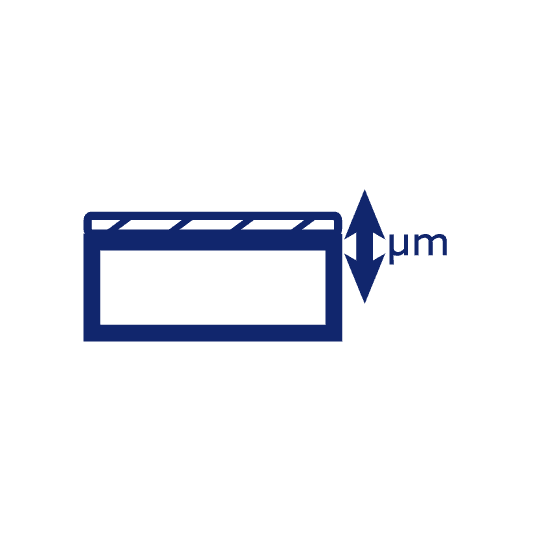
The typical thickness for a hard anodised coating is 50 microns, but the Apticote process employs special jigging and power supplies to allow for thicker coatings of up to 75 microns. Apticote 300M uses a proprietary technique to achieve a thickness of up to 150 microns and is an ideal thermal barrier.

Uniform coverage
Our anodising process has been refined to ensure even coverage across the part. We can successfully process the anodising of blind holes and along the inside of tubes to a depth of equal to 10 times the diameter. It is important to note on all anodising processes that a small area is left uncoated at the electrical contact points.

Excellent paint adhesion
Anodising is an ideal solution as a pre-treatment for paint due to its excellent adhesive properties. Anodising leaves the substrate clean and the micropores provide a key for subsequent painting of the part.

Coats a range of aluminium alloys
Anodising can be applied to most aluminium alloys including those most used in aerospace and defence applications – grades 2124 (T3), 7175 and 6082. Alloys with a silicon content greater than 10% or more than 5% copper are unsuitable.

Can be dyed black or red
Anodised parts can be dyed, with the porous surface being ideal to take on the colour. The results depend on the alloy content and colours can fade over time and therefore colour matching between batches cannot always be guaranteed. We can currently offer either red or black dye.

Dielectric strength
Breakdown voltage increases with film thickness. Coatings normally withstand voltages in excess of 1,000 volts DC. Unlike most insulators, Apticote 300 hard anodised coatings can operate at temperatures up to 2,000°C. Its combination of high dielectric strength and thermal stability make Apticote 300 the ideal surface for mounting electrical components.
- Gears and pulleys
- Valve blocks
- Hydraulics
- Pneumatics
- Pistons
- Hinges
- Swivel joints
- Nozzles and venturi
- Rod-ends
- Food chutes
The diagram illustrates how the anodising process causes equal growth of the aluminium oxide layer both internally and externally.

Anodising creates a micro-column structure. For maximum protection, anodised layers are usually sealed immediately after the main coating process, filling the micro-columns and preventing access to the substrate. Typical sealing techniques include: Hot water, Nickel acetate and Di-chromate (Aerospace only). It is also possible to infuse the layer with a polymer – see Apticote 350/355.

Refine Your Search
Use our coating selector form to filter by material and application options to find the perfect treatment based on your requirements.
Or, get in touch today and a member of our team will be happy to help