
Thermal Spray Design Guide
Coating Description
Thermal Spray is a range of high-performance ceramic, cermet and metallic coatings that can be applied to a range of steel, titanium, aluminium, and copper alloys, as well as to some non-metallic substrates.
We can offer state-of-the-art thermal spray solutions through our Gloucester Thermal Spray Centre of Excellence. Featuring sophisticated computer-controlled five-axis robots, as well as an experienced and highly skilled team of operators, we can process complex components to a range of different specifications.

To maximise the results of our thermal spray processes, it is important to design components with thermal spraying in mind as well as specifying the correct coating. That’s why we’ve created this guide to help engineers get the most out of our thermal spray coatings.
Thermal Spray Processes
There are a variety of different thermal spray processes, each one projects a stream of melted particles at high velocity onto a substrate. The nature of the process means that it can only ever be applied in the line of sight, and for the most part, the bond between the coating and the substrate is purely physical.
There are six thermal spray processes available:
Wire Spraying
A metal or alloy wire (e.g. copper, stainless steel) is fed through an oxy/acetylene flame. The material melts and is blasted onto the part by compressed air.
Powder Spraying
Similar to wire spraying, but the metallic material is fed into the oxy/acetylene flame as a fine powder.
Electric Arc Spraying
The metal feedstock is composed of two wires, brought together at the gun nozzle with a high voltage electric arc struck between them. The melted feedstock is atomised by compressed air and projected at the substrate.
Plasma Spraying
A compressed gas (usually argon, hydrogen or nitrogen) is ionised by a high voltage across a copper anode and tungsten cathode to create a plasma. The powder is heated to a very high temperature and blasted at a part by the compressed gas.
HVOF – High-Velocity Oxy Fuel
Fuel, consisting of kerosene, acetylene, propylene and hydrogen is ignited with oxygen and projected by compressed air. It is further compressed through a long barrel before the material is fed into the stream as a powder. It produces a very high-velocity stream of material, but at a relatively cool temperature, so is ideal for cermets, but not ceramics.
D-Gun – Detonation Gun
A charge of powder is fired at part by a repeating detonation, normally about eight times a second. The fuel is an acetylene/oxygen mix, ignited by a synchronised spark, producing an extremely high-velocity stream. Like HVOF, it is relatively cool, ideal for cermets and generally considered to produce the densest coatings.
You can read more about the types of thermal spray in our article here.
Coating Structure
Regardless of which thermal spray process is used, the resulting structure of the coating is broadly similar.
The simplified diagram shows how the wire or powder material is melted and then blasted against the substrate.
These molten particles ‘splat’ when they hit the substrate, then begin to shrink and solidify as they cool. As the material is sprayed the particles overlap each other and create a mechanical bond with each other and the substrate. This is why the surface preparation of the substrate is important to ensure a strong bond is achieved.

Depending on the material being sprayed, there will be varying levels of porosity within the final coating.
Specifying a thermal spray coating
Thermal spray coatings can use a wide variety of materials and can be applied to a wide variety of substrates. This means that it is an ideal choice for a range of applications such as wear resistance, corrosion protection, salvage and thermal barriers. It is important to clearly define what the coating is required to achieve before beginning the coating selection. Below are some examples of the best thermal spray materials for each application, but our thermal spray team are always on hand to provide further guidance for specific applications.
Low-Stress Abrasive Wear
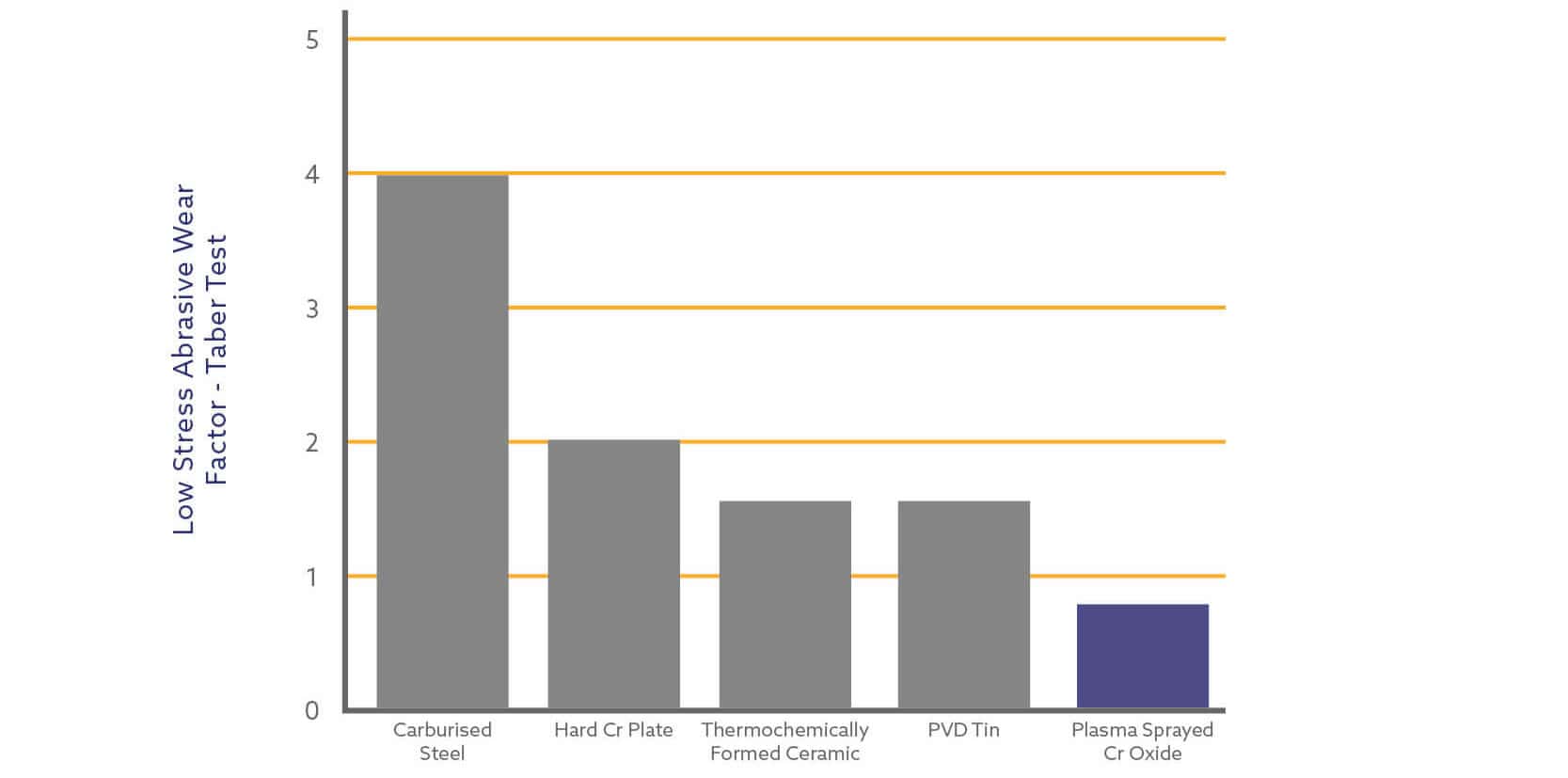
This often occurs in industries such as textiles, plastics and food production, where micro-particles in the product cause abrasion of machine parts. The best thermal spray solution to prevent any potential machine downtime is usually a plasma sprayed ceramic, like chromium oxide.
High-Stress Abrasive Wear
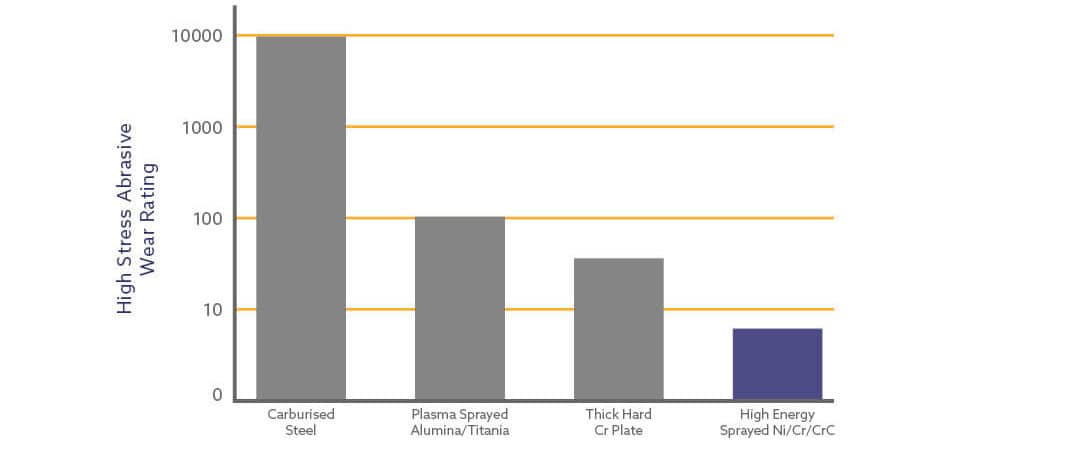
Occurring in pumps, valves, and conveyors where aggressive debris or product is heavily loaded against operating surfaces. The solution will need to be an extremely tough, hard, high energy thermal coating to protect against this.
Fretting & Surface Fatigue
These problems require tough, rather than hard coatings, with materials like nickel-based alloys that resist cracking and oxidation – both characteristics of fretting fatigue. Applications include cam-followers, rocker arms, expansion joints, seals, and press-fit spacers.
Erosion
Erosion, either by impinging particles or fluids (sometimes with cavitation) is best resisted by tough, rather than hard coatings. Applications include exhaust fan blades and seats, turbine nozzles and dust collectors.
Salvage
Parts that have been damaged, worn or eroded can be reclaimed by thermal spray coatings. The damaged area is cleaned up, blasted then coated with new material. Components are coated to an oversize before being machined or ground back to their final size.
The coating must, in general, match the substrate regarding composition and hardness – including their required machining or grinding characteristics.
Corrosion and Stress Corrosion
Nickel, chrome or cobalt-based spray coatings are available for protection and are usually sealed to close any residual porosity. On high strength steel or aluminium substrates, a corrosion-resistant coating, sometimes followed by shot peening, can combat stress corrosion and eliminate cracking failures.
Thermal Barriers
Ceramic coatings, such as alumina, MCrAlY or yttria stabilised zirconia, provide low conductivity and an oxygen diffusion barrier, protecting vulnerable substrates.
Applications include piston crowns, rocket nozzles, missile nose cones and carburising boxes.
Read more about thermal barrier coatings and how they work here.
Electrical
Conductivity – sprayed metals like copper for lightning arrestor and ground connectors.
Resistivity – dense, pore-free sprayed ceramics for the highest dielectric constant, for insulation applications, for example, heater tubes, soldering tips and electronic parts.
Shielding – sprayed coating to absorb and earth stray RF induction and others to shield against gamma rays or thermal neutrons. Applications including instrument assemblies and missile systems.
Bedding-in
The classic application for thermal spray coatings is for turbine stators, where an abradable coating such as nickel/graphite is applied.
Abrasive coatings on the turbine blade tips then cut the stator surface, creating the perfect dimensional match, with the minimum blade/stator clearance.
Coating Selection Matrix
Based on the information above, you can select the best thermal spray for your application from the table below:

Surface Preparation & Masking
After degreasing, components are grit-blasted before coating. This important step ensures a high bond-strength mechanical key with the coating is achieved. Very thin sections should be reinforced, as a part of the design, since the compressive stress imparted to a surface can sometimes distort the component.
Masking can be achieved by mechanical shields and robust tapes – although this is a time-consuming step. It is worth consideration at the design stage whether a part can be coated all over as in many cases this is a much easier and more cost-effective option.
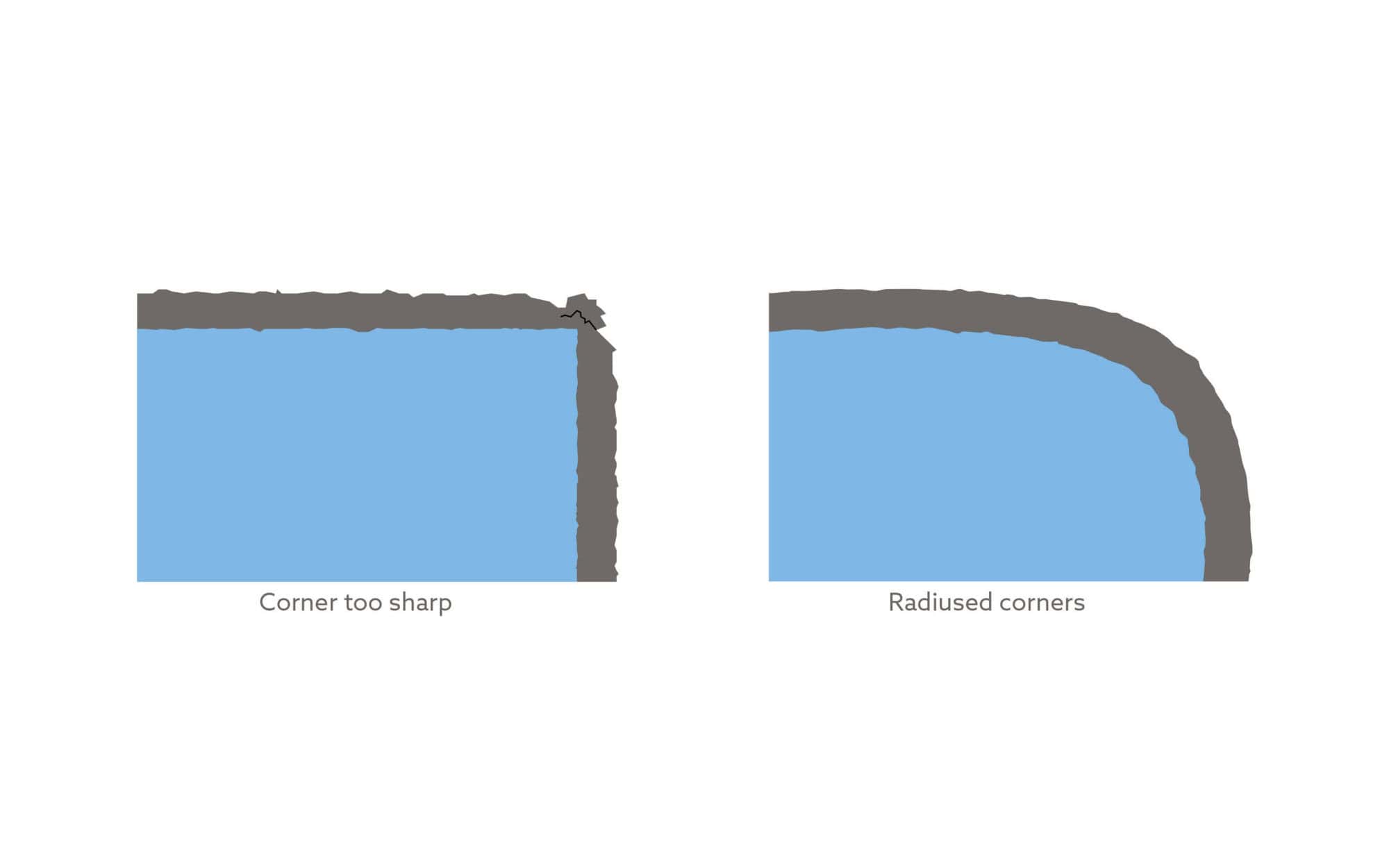
Spraying up to and around a sharp corner is difficult and can lead to chipping. If possible, corners should be radiused as per the diagram below to prevent this.
Surface Finish & Thickness
Coating thickness can be up to several mm, particularly for salvage applications, but most ceramics, cermets and metal/alloy coatings are applied between 250 microns and 1mm. The as-sprayed finish is rough, around 10 microns Ra. so most parts (excluding, for instance, some thermal barriers) will need post-grinding or machining. We will be able to advise on procedures about specific applications and coatings.
Porosity
Metal and alloy coatings exhibit near-zero porosity. However, ceramics and cermets applied by high-temperature plasma spraying, require the most rigorous quality control of the spray parameters, to ensure they achieve porosity levels of below 2%.
Deliberately controlled porosity levels are essential in thermal barrier coatings however. Read more about TBCs here.
Substrates
Hardened steel or other hard substrates (>450Hv) can post difficult problems in obtaining a good coating bond and should be avoided.
Plastics, composites, and graphites can, unusually, be used as substrates, but Poeton will advise on specialist spraying techniques required.
Efficiency & Costs
The cost of the materials that are used is an important element of the total processing costs in thermal spray applications. Each wire or powdered material has a different cost and different efficiency. This means that maximising efficiency is crucial in providing value in thermal spray processing. This is why we employ state of the art thermal spray equipment combined with two 6 axis robots along with a high-performance thermal spray controller to allow our thermal spray team to offer the ultimate in spraying performance.
Quality Control
The highest quality thermal spray coatings are provided by utilising the in-house Poeton laboratories. The quality control process covers testing the thickness, porosity, substrate bonding and coating structure. Examination of sprayed samples that represent coating parts prevents the need for destructive testing on production components.
Specifying the Coating
When placing an order for Poeton Apticote 800, be sure to specify your requirements, specifically:
- Coating type: the material and its Apticote designation
- Coating thickness and tolerances
- Base material: composition and hardness, and any restriction on distortion during pre-blasting
- Surface to be coated: provide a drawing, including coating terminations and masking requirements
- Final dimensions: for example, finished ground or turned size
- Specification: customer or national approval system to be worked to